Update to Crowdfunders
Dear Friends,
Today, after more than six years, the Employment Appeal Tribunal handed down its judgment in my appeal concerning my wasted costs application against the NHS law firm Hill Dickinson.
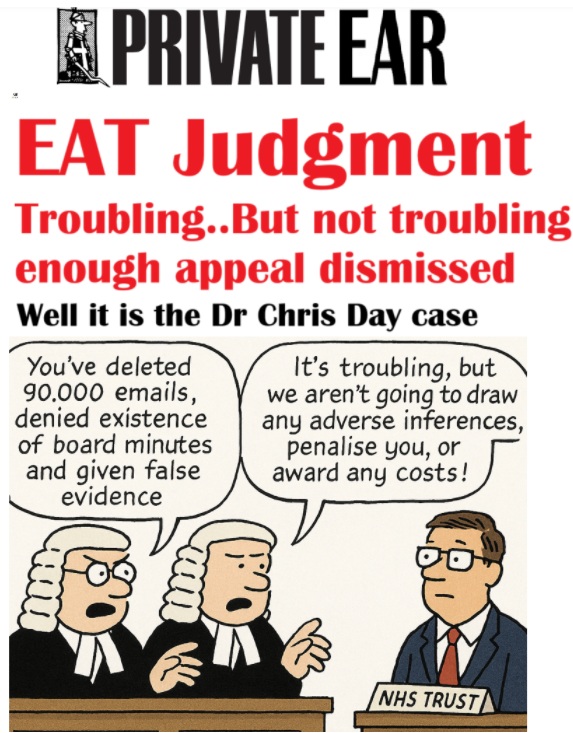
I am afraid it is more of the same. Faced with evidence of hidden contracts, the Tribunal’s response echoes what happened when 90,000 emails were deleted during the litigation. Rather than investigating the significance of the hidden contracts, it concludes that they made no difference. In my view, that conclusion is impossible to reconcile with the obvious effect those contracts had: they contradicted HEE’s position, caused it to collapse after four years of litigation and the expenditure of vast sums of public money, and ultimately led HEE to concede that 54,000 junior doctors were entitled to whistleblowing protection. Those points were also raised by two former lawyer MPs in Parliament, but the judgment chooses not to engage with their substance of a number of our ground of appeal.
I wanted you to hear the outcome directly from me because none of this would have been possible without your extraordinary support over the last twelve years as I made clear on Channel Four News.
As many of you know, this application was not just about recovering your crowdfunds, it was also about accountability. .
Between 2014 and 2018, public money was spent arguing that I- and around 54,000 English junior doctors (now called Resident Doctors) – did not have whistleblowing protection against Health Education England, the NHS body responsible for commissioning, funding and controlling our training and careers.
When I argued that Health Education England exercised substantial influence over junior doctors, my position was dismissed as “fanciful.” The Employment Tribunal accepted that submission. When I challenged it in the Employment Appeal Tribunal in 2016, I was threatened with costs and sent a schedule exceeding £24,000 for doing nothing more than defending whistleblowing protection of the nation’s doctors and trying to have my own whistleblowing case heard by a court.
The argument against me was said to be supported by all the contemporaneous documents before the court.
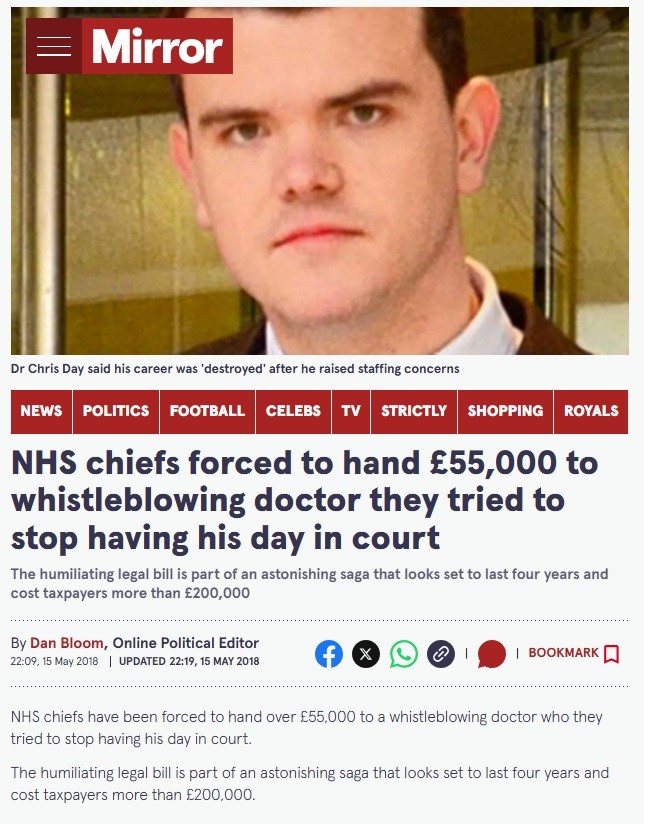
Four years later, shortly before the rehearing ordered by the Court of Appeal, an older version of one of the NHS commissioning contracts emerged. Health Education England immediately abandoned the very argument it had spent four years defending, accepted that I was its worker for whistleblowing purposes and agreed to pay £55,000 towards my costs.
After my whistleblowing case had settled, journalist Tommy Greene then obtained, through the Freedom of Information Act, the actual 2014 commissioning contract that applied to my case. It had been drafted by the same law firm acting for Health Education England and became the basis of my wasted costs application.
Today, the Employment Appeal Tribunal has dismissed my appeal.
I respectfully disagree with that decision.
My difficulty with the judgment is that it never really grapples with the chronology of what actually happened.
In 2015, the Employment Tribunal accepted Health Education England’s submission that my case on HEE’s substantial influence over junior doctors was “fanciful” and contradicted by the contemporaneous documents before the court. That finding stood for almost four years.
It was only after NHS commissioning contracts began to emerge that Health Education England abandoned that very argument, accepted that I was its worker for whistleblowing purposes and agreed to pay £55,000 towards my costs.
The Employment Appeal Tribunal has now upheld the conclusion that the later discovery of those commissioning contracts drafted by the same law firm accusing me of being fanciful made no material difference.
For me, that remains the central unanswered question.
How can contracts whose emergence was followed by the complete collapse of Health Education England’s four-year legal position and a £55,000 costs payment now be said to have made no material difference?
That is why I remain disappointed by today’s judgment.
It seems to me that the judgment largely sidesteps the serious questions that I, two Members of Parliament and journalists have been asking for years about the non-disclosure of the commissioning contracts and the use of public money in this litigation.
It also side steps several of our Ground of Appeal which you can read here.
Despite today’s disappointment, I have no regrets.
Together, we established whistleblowing protection for thousands of doctors.
Together, we exposed documents that should have been available years earlier.
Together, we ensured these issues were examined publicly rather than quietly disappearing.
None of that would have happened without your support.
I have not yet made any decision about whether to seek permission to appeal to the Court of Appeal.
If those who have supported this case over the years believe these issues deserve to be considered by the Court of Appeal, I am prepared to continue the fight. However, an appeal to the Court of Appeal would inevitably involve significant further legal costs and would only be possible with substantial additional crowdfunding support.
This case has never belonged to me alone. It has been sustained by thousands of people who believed that patient safety, whistleblowing and accountability matter.
Whether this is the end of the road, or whether we ask the Court of Appeal to consider these issues, is ultimately a decision I would like to make together with those who have stood beside me throughout this journey.
It seems to me that the way NHS executives, their lawyers and, ultimately, the courts have dealt with this case goes to the heart of the toxic culture that allows cover-ups to persist in the NHS. If hidden contracts and the destruction of 90,000 emails can be dismissed as making no material difference, it raises profound questions about accountability.
Taking this case to the Court of Appeal presents a unique opportunity to have these issues considered afresh. My hope is that a Court of Appeal constituted by three Lord or Lady Justices would give the legal and public interest issues the rigorous scrutiny that I believe they deserve perhaps in a way the lower courts have not felt able to do for whatever reason.
I am in your hands. Click here to support a possible appeal to the Court of Appeal.
Whatever happens next, I want to thank every one of you for believing that the NHS should be accountable to its patients, its staff and the public it serves.
With my sincere gratitude,
Dr Chris Day
Private Ear Coverage Click here